
BIRD, ROBERT THOMAS
Rank:
Service No:
Date of Death:
Age:
Regiment/Service:
Text on stone:
Grave Reference:
Rank:
Service No:
Date of Death:
Age:
Regiment/Service:
Grave Reference:
Text on stone:
Lance corporal
5117094
21/09/1944
29
Oxford and Bucks Light Infantry 1st Bn.
I. B. 9.
Grant him, o Lord eternal rest
Additional Information:
Son of Joseph and Alice Bird, of Cleobury Mortimer, Shropshire.
Robert was born in april 1915, Cleobury Mortimer, Shropshire, U.K. He got mortally wounded around the Wilhelmina Canal near Oirschot, the Netherlands. The father of Thomas, Joseph Bird, was killed during the first World War. He died on 12 January 1917, aged 35. He is buried at Couin British Cemetery in France.
Robert was initially buried at Oerle.

From the service records of Robert Thomas Bird, the following account can be reconstructed.
Robert Thomas Bird was born on 10 May 1915 in Cleobury Mortimer, Shropshire. In civilian life he worked as a clerk. He was described as being 5 feet 8 inches tall, with hazel eyes and brown hair. He was unmarried.
He joined the British Army on 16 May 1940, enlisting with the Oxfordshire and Buckinghamshire Light Infantry.
Robert was deployed to North-West Europe on 24 June 1944 as part of the Allied campaign following the Normandy landings.
Robert Thomas Bird was killed in action on 21 September 1944.
. The
Americans at Best were still drawing away the enemy from the path of the 43rd,
but that respite was to be short-lived as other enemy units were shadowing the
movement of the Battalion as they retreated in tune with the British advance.
There was no doubt that the 43rd were due for a surprise at the Wilhelmina
Canal!
On the
evening of the 20th September, with the noise of shooting becoming more
pronounced, many local inhabitants of De Kruisberg moved out of their houses to
look for safe shelter from the advancing dangers of war. The Dankers
family with their ten year old son Martin, left their house in a hurry
as a group of five wounded Germans were deposited on the floor on stretchers,
accompanied by some German soldiers including medics. One of the medics went
searching for assistance and found the local baker, Wilhelm Van der Loo.
He was asked for urgent help with the wounded and it was suggested he contact
the advancing British troops as the only ones likely to have adequate medical
facilities for the task. Van der Loo, by the nature of his job, was well
known in the area but he was not a member of the Dutch Resistance and was not
aware of the difficulties that might arise in such a venture. He worked with
his father and brother at the family bakehouse at nearby Middlebeers and saw
this as an opportunity to be one of the first in the area to make direct
contact with the British advance. There was no doubt that he could provide
helpful information if required regarding the deployment of what was left of
German troops in the area. Unfortunately the British were not in a position to
identify him. Unknown to this brave young Dutchman, he was about to embark on a
perilous venture. Within the next three days he was to be mistrusted by the
British, and having escaped from that dilemma, find his mother and sister
killed in the cross-fire as the British liberated the area.
As Van
der Loo moved off into the darkness to meet the expected forward elements
of the 43rd Light Infantry, events at the Dankers farmhouse had taken a
turn for the worse. The German soldiers, a group of ruthless Waffen SS, were
about to set a trap for the British party. Unknown to the wounded, the German
soldiers, who appeared to be waiting patiently for their prey to arrive. Of this,
Van der Loo was not aware.
“D”
Company continued in the lead towards De Kruisberg with Private John Ellis
in 16 Platoon taking over from his section-commander at the front. He
considered this position worth the risk, in order to be free of his turn at
carrying the heavier weapons, such as the Bren-gun or the PIAT, at the back of
the section. Ellis moved along what appeared to be a single line small
gauge railway track. Just before midnight he suddenly heard the approach of
footsteps in the dark, and gave the `Go to ground’ signal to those following.
He challenged the approaching form silhouetted against a somewhat lighter sky.
The tired looking Dutchman who spoke broken English was Van der Loo. He
asked to see the officer in charge and was accompanied by Ellis back
along the halted line of infantrymen to the mobile Company HQ where he was
introduced to Major Ivor Jenkins.
The halted
infantrymen looked out apprehensively into the hostile darkness whilst section
and platoon commanders and sergeants took the opportunity of re-arranging the
position of some of their men and arms in the sections and Ellis ended
up carrying two cases of 2″ mortar bombs stuck on the back of a bike.
Meanwhile
the Dutchman explained to Major Jenkins that he had been sent by a group
of German soldiers who wished to surrender so that their comrades could have
proper medical treatment. He gave directions as to their whereabouts in a house
about two hundred yards ahead but was hesitant when asked to accompany the
British detachment to secure the wounded prisoners. Jenkins had no way
of checking his name in such a short space of time and became suspicious,
leaving the Dutchman under observation whilst he went off to brief Lieutenant Geoffrey
Fuller, the commander of 17 Platoon. He instructed Fuller to take
two sections from his platoon and, with the Dutchman as guide, seek out the
Germans and provide as much medical assistance as was possible under the
circumstances and take prisoners, if the opportunity occurred. If a trap was
suspected, there was no doubt that Van der Loo was to be held prisoner
or shot if he attempted to escape.
It was
before midnight when Fuller and his two sections came within sight of
their objective at the hamlet of De Kruisberg to the right of the road,
accompanied by the Dutchman under escort. Voices could be heard in the darkness
coming from the outline of a large house just ahead, but no movement was
visible. One section with Fuller and his section-commander, Corporal Douglas Woodward,
entered by a door at one end of the building and commenced to search their way
through a corridor interconnecting rooms on the ground floor. The Dutchman was
now in a hostage situation under the eye of Lance Corporal Percy Brown
who followed close behind his platoon commander. If things went badly wrong for
the British detachment, there was no doubt that the unfortunate individual
would be first to be killed. If the Germans didn’t get him, the British would.
Partially surrounding the building was the other section with Platoon Sergeant Gordon
Hay and Corporal Jim Wilsdon ready to give covering fire with the
remainder of “D” Company moving up along the path adjacent to the
building. Behind them followed the remainder of the Battalion.
As Fuller
and his men entered the first room at one end of the dimly lit building he came
upon two seriously wounded German soldiers lying on the floor in a
semi-conscious state and found two more situated in the next room. Fuller
doubtful whether such limited medication could save their lives. In the third
room along, they came across another British party. Fuller suddenly
realised that the sense of urgency and fear in the man’s voice was some kind of
warning and he feared a trap. He immediately shouted orders to evacuate the
building as quickly as possible. His shout of warning alerted the Germans
waiting in ambush at the other end of the building and all hell broke loose.
Just as the first man hastily emerged into the darkness, there was a thunderous
roar and a white flash from the other end of the building as phosphorous
covering the whole of the ground floor ignited. The heat, brightness and noise
increased with intensity as it raced through the the building at lightning
speed, engulfing the building in a mixture of bright white flame and dense
black smoke that threatened incinerate the British soldiers and the Dutchman as
they rushed back the way they had come, falling over each other in haste. In
the confusion, Van der Loo, suddenly realising the seriousness of his
situation, detached himself from Percy Brown and hid behind a table
before dashing outside to freedom. Percy was more than grateful to find
himself in one piece and thoughts of the Dutchman were not foremost in his mind
at that particular moment! The victims of the trap were the German wounded,
sacrificed by their own side, in an incredible attempt to entrap the British
party. At the other end of the building the perpetrators of this vile deed
fired at the escaping infantrymen, their task made easier by the fact that the
escapees retained much of the phosphorous on the soles of their boots, thus
pin-pointing their running forms by the reflective qualities of the chemical.
But for the quick intervention of the covering section, casualties could well
have been high.
By now, 16
Platoon had deployed themselves in single file towards the back of the house
where Private John Ellis and Private Albert Burroughs came under
heavy enemy fire from a Spandau position nearby. Ellis dropped the bike
in a hurry and dived with Burroughs for cover.
“We
both hit the ground with a complete mix-up of platoons and sections, all
seeking safe ground to avoid the spray of bullets now striking the wall of the
cottage, just twelve inches or so above ground. We crawled to the end of the
cottage for cover, but after a short pause, the Spandau started up again and we
were nearly caught out by its movement to an alternative position, or it might
even have been a second Spandau for all we knew. Moments later tracer shots
ignited a hay-stack about one hundred yards away and everyone became
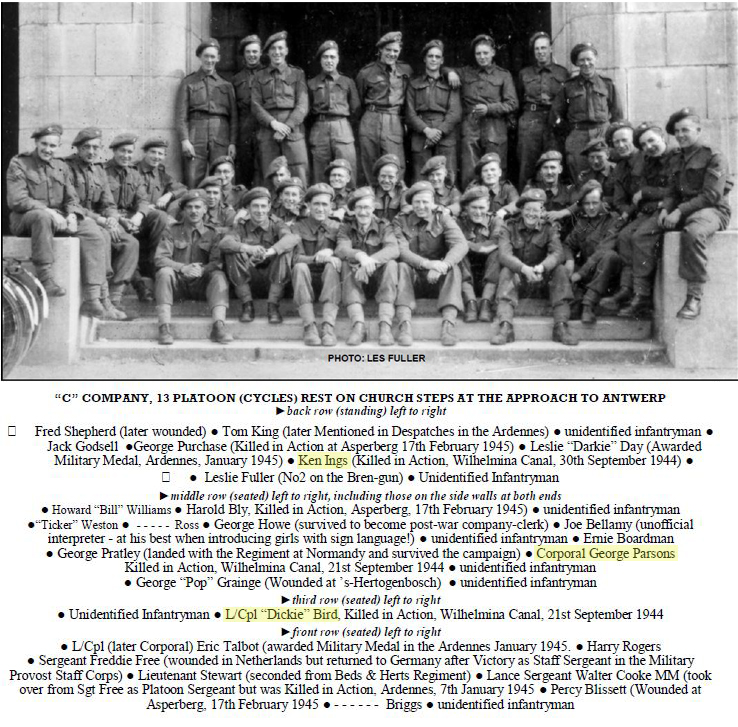
silhouetted against the cottage. Lance Corporal “Dicky” Bird from Cleobury
Mortimer, Shropshire, the “D” Company office clerk at Faversham,
dived towards an outside toilet for cover and slammed the door behind him, only
to be killed as the Spandau found its mark. Another 16 Platoon infantryman to
be killed in the early hours was Pte Dennis Hammersley of Nuneaton, Warwickshire,
whilst, several others were wounded before we all recovered our balance to
retaliate.”
Still under
heavy fire, Ellis and Burroughs found themselves in a gully next
to Captain Ashcroft (Formerly 8th Irish Bn, The Kings Regiment) who
suggested to those within earshot, that everyone should fend for themselves.
Although not a textbook approach as prescribed by the infantry manual, it found
favour with the two infantrymen next to him and they didn’t require any further
encouragement to beat a hasty retreat, although at one point they had regrets
as a burst from a Spandau nearly caught up with them. They both ran in the
direction from where they came, zig-zagging and
dropping to
the ground every few yards to avoid the bullets, eventually reaching a ditch
where Major Jenkins and CSM ‘Trotter‘ Mitchell, somewhat
surprised by the hold-up, were about to turn their thoughts to a response in
the form of mortars and Brens. Due to enemy action, orders were received to
make camp and await dawn before initiating another attack on the enemy position
just beyond De Kruisberg.


Memorial in the Cleobury Mortimer church.