
INGS, KENNETH
Rank:
Service No:
Date of Death:
Age:
Regiment/Service:
Text on stone:
Grave Reference:
Rank:
Service No:
Date of Death:
Age:
Regiment/Service:
Grave Reference:
Text on the stone:
Private
14706556
30/09/1944
19
II. C. 20.
Oxford and Bucks Light Infantry 1st Bn.
The love that never falters the love that pays the price and makes, undaunted, the final sacrifice
Additional Information:
Son of William Bertie and Elsie May Ings, of Snelston, Derbyshire.
Private Kenneth Ings was born on 5-9-1925 in Snelston, a small village close to the market town of Ashbourne, in Derbyshire. He went to school in Norbury, a neighbouring village, until the age of 14 when he went to work on local farms. He signed up at the age of 18 but was killed in action soon after at the age of 19. Ken was one of nine children of Elsie-May and William Bertie Ings, six boys and three girls, from which four of the boys went to war. John Rupert (Jack) was in the navy and went down on the Exeter and later died in a Japanese prison camp. Stan was missing feared dead for 2 years after escaping from a prison camp in Italy, but did come home. Reginald Bevan won the Military Medal for bravery. Ken, the youngest, was killed in action. This must have been a dreadful time for their mother and she later dedicated a bible to her sons which is in Snelston Church to this day.
He was one of 9 children of William Herbert (“Bertie”) Ings and Elsie (nee Rawlins). Kenneth grew up in Ashbourne and his family were still living there in 1939. At some point during the 2nd World War, Kenneth enlisted as a Private in the 1st Battalion of the Oxfordshire and Buckinghamshire (‘Ox and Bucks’) Light Infantry. At the time he joined up, his place of residence was given as Lincolnshire.
He died of wounds in the fieldhospital in the village of Meerveldhoven and initially buried there.

Original gravesite at Meerveldhoven.

From the service records of Kenneth Ings, the following account can be reconstructed.
Kenneth Ings was born on 5 September 1925 in Eastbourne, Derbyshire. In civilian life he worked as a lorry driver. He was not married.
He enlisted in the British Army on 3 February 1944 and joined the General Service Corps. On 16 March 1944 he was transferred to the Oxfordshire and Buckinghamshire Light Infantry.
Kenneth Ings embarked for service in North West Europe on 17 August 1944.
According to his service records, he was 5 feet 9½ inches tall, with dark brown hair and blue-grey eyes.
Kenneth Ings died of wounds on 30 September 1944.
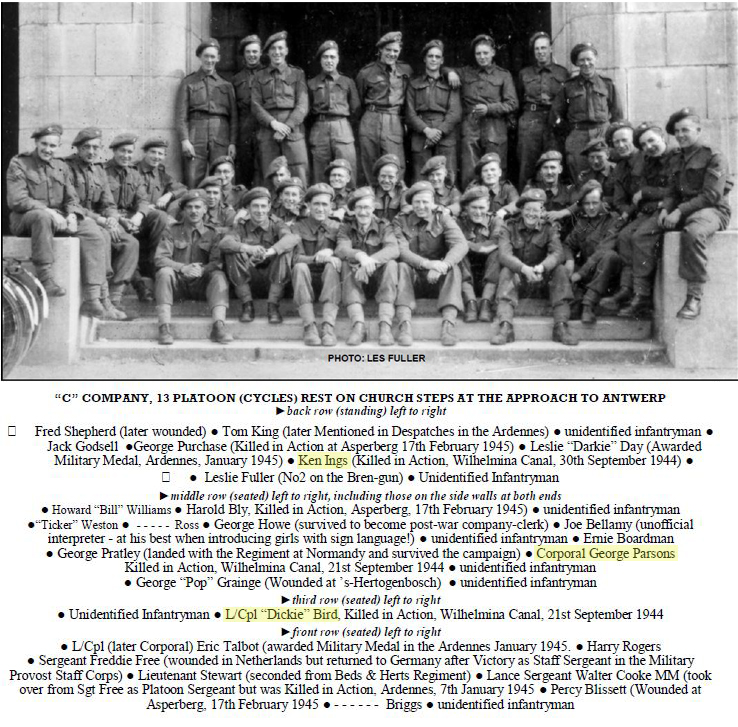
From the 27th September till the 5th October, the Regiment remained in the vicinity of the village of Dun in wet, miserable weather. Of some concern was well directed mortar and 20mm gun fire associated with an observation post in the tower of Oirschot Church. Divisional artillery were brought up to use the building for target practice, and demolished its revered heritage. Both “C” and “D” Company kept an eye on intruders from the far bank, who appeared at times as though by magic in a number of cottages on the British side of the canal. Six infantrymen, including Private Ellis, from 16 Platoon, were sent to a cottage with a commanding view of the cottages in question. Through a sky-light in the roof the men kept observation on both sides of the canal. As night approached on 30th September, 20mm cannon-fire, possibly used to divert attention away from an enemy canal-crossing party, was directed into fields behind the 16 Platoon position. It fell in the midst of 13 Platoon, “C” Company, whereupon stretcher-bearers raced to the scene still under fire. There were numerous wounded and Private Kenneth Ings of Snelston in Derbyshire, was killed. There were also numerous patrols during this period. On two consecutive days, 1st and 2nd October, Platoon Commander, Lieutenant Norman Woolven of Eastbourne, Sussex, posted as a reinforcement from the Queen’s Own Royal West Kent Regiment, led patrols into enemy held territory. The first patrol was a success with a number of the enemy taken prisoner, but on the following day he suddenly came face to face with a German patrol and both parties fired their weapons simultaneously. Lieutenant Woolven did not survive the exchange of fire. On the 5th October the Regiment was relieved and moved back to Derle for the night to come under the temporary command of the 160th Brigade from whom it received orders to move up to the Nijmegen bridgehead as reserve battalion, there reverting once again to the 71st Brigade.


