Rank: Service No: Date of Death: Age: Regiment/Service:
Grave Reference:
Rank: Service No: Date of Death: Age: Regiment/Service:
Grave Reference: Text on stone:
Lieutenant 308191 02/10/1944 22 Queen’s Own Royal West Kent Regiment seconded to 1st Bn. Oxford and Bucks Light Infantry I. B. 2. “Brief, brave and glorious was his young career” Patricia his wife, mum and dad
Additional Information: Son of Maj. Arthur George Woollven and Lilian Emily Woollven; husband of Patricia Mary Woollven, of Eastbourne, Sussex.
Initially buried at the town of Oerle.
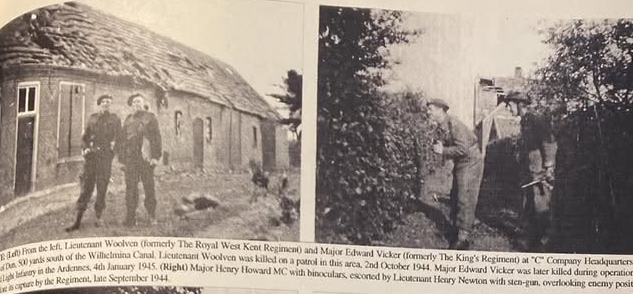
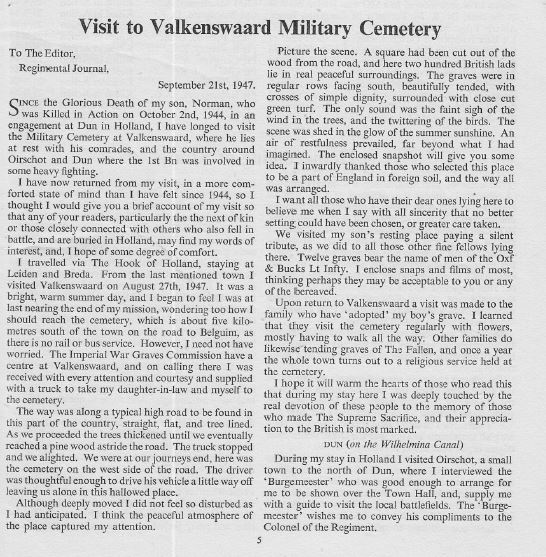
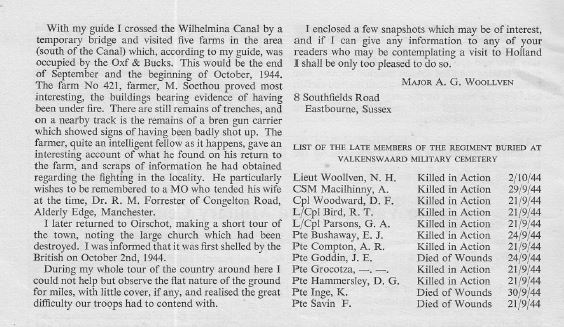
From the 27th September till the 5th October, the Regiment remained in the vicinity of the village of Dun in wet, miserable weather. Of some concern was well directed mortar and 20mm gun fire associated with an observation post in the tower of Oirschot Church. Divisional artillery were brought up to use the building for target practice, and demolished its revered heritage. Both “C” and “D” Company kept an eye on intruders from the far bank, who appeared at times as though by magic in a number of cottages on the British side of the canal. Six infantrymen, including Private Ellis, from 16 Platoon, were sent to a cottage with a commanding view of the cottages in question. Through a sky-light in the roof the men kept observation on both sides of the canal. As night approached on 30th September, 20mm cannon-fire, possibly used to divert attention away from an enemy canal-crossing party, was directed into fields behind the 16 Platoon position. It fell in the midst of 13 Platoon, “C” Company, whereupon stretcher-bearers raced to the scene still under fire. There were numerous wounded and Private Kenneth Ings of Snelston in Derbyshire, was killed. There were also numerous patrols during this period. On two consecutive days, 1st and 2nd October, Platoon Commander, Lieutenant Norman Woolven of Eastbourne, Sussex, posted as a reinforcement from the Queen’s Own Royal West Kent Regiment, led patrols into enemy held territory. The first patrol was a success with a number of the enemy taken prisoner, but on the following day he suddenly came face to face with a German patrol and both parties fired their weapons simultaneously. Lieutenant Woolven did not survive the exchange of fire. On the 5th October the Regiment was relieved and moved back to Derle for the night to come under the temporary command of the 160th Brigade from whom it received orders to move up to the Nijmegen bridgehead as reserve battalion, there reverting once again to the 71st Brigade.